
I spoke at an ACG panel last week with two hundred private equity operators in the room, and the question everyone wanted answered was: "How do we actually use AI in our portfolio companies?"
Not "what's possible with AI" or "what's the future of AI", those are conference talks. They wanted tactical answers. What can we do this quarter that will show up in EBITDA? How do we know it's working? What's the investment required?
Here's the framework we use with PE operators who need to move fast.
⚡ Quick answer
Start with Horizon 1 productivity plays (five-figure investment, 90-day ROI). Prove value, build confidence, then move to Horizon 2 differentiation (six-figure investment). Most PE operators should skip Horizon 3 unless it's a pre-exit platform build.
📖 Table of Contents
Two use cases that actually matter
Every AI conversation eventually splits into two paths, and the distinction matters because the investment thesis is completely different.
Path 1: Save money (operational efficiency):
This is the obvious play. Take existing operations, identify manual workflows, automate them with AI. The math is straightforward, analyst spends 20 hours a week on data entry, AI handles it in 20 minutes. That's 19.7 hours of capacity returning to the business.
Most portfolio operations teams start here because the ROI is measurable and the risk is contained. You're not changing the business model; you're making the existing model more efficient.
We've seen this work across customer support, document processing, data analysis, reporting, and compliance workflows. Teams that automate manual review work free up a large share of their operations capacity, so the same team handles far more volume.
The payback period is often short enough to show up inside a single quarter.
Path 2: Make money (product differentiation):
This is the more interesting play but requires different thinking. Instead of using AI to do existing work faster, you use it to do work that wasn't possible before.
Consider an AI-powered culture audit. It analyzes Slack message patterns, identifies company values from actual usage, then configures recognition programs around real culture instead of aspirational culture.
That's not automation, that's a new product line that couldn't exist without AI. The investment thesis isn't labor savings; it's revenue expansion through differentiation.
Or consider an AI assistant for a professional services firm. Not to make analysts more efficient (though that happens), but to give clients capabilities that competitors can't match. The AI becomes the moat.
These paths aren't mutually exclusive. Most portfolio companies should pursue both, but the investment approach, timeline, and success metrics are different. Knowing which path you're on prevents confusion about what you're trying to achieve.

Two paths: Save money through efficiency or make money through differentiation
The three horizons framework
Within each path, AI investments fall into three horizons. This framework comes from our portfolio operations playbook and helps operators think about where to invest first.
Horizon 1: Productivity (0-6 months):
Quick wins that improve existing workflows. The goal is immediate ROI through operational efficiency, AI-powered search that makes internal knowledge accessible, automated report generation, meeting transcription and summary, data extraction from documents.
Market range for these implementations: $10K-50K, with timelines of 4-12 weeks to deploy and measurable impact within 60 days.
Take AI-powered meeting transcription across an operations team. Every hour that stops going to note-taking returns to productive work, and it adds up fast across a whole team.
At typical loaded costs for operations staff, the monthly capacity value can exceed the one-time implementation cost within weeks.
Horizon 1 is where skeptics become believers, the impact is tangible, the investment is manageable, and the risk is minimal.
Horizon 2: Differentiation (6-18 months):
Building AI capabilities that become competitive advantages. This is where you're not just improving operations but changing what the company can deliver.
Examples include AI-powered customer insights that inform product development, automated decisioning that scales operations without headcount, predictive analytics that anticipate customer needs, and embedded AI features that differentiate the core product.
Market range for these investments: $100K-500K in development, with timelines of 3-6 months to build and validate, showing impact through revenue growth or margin expansion over 12-18 months.
Picture a B2B service business that builds AI-powered document review to automate part of its manual verification process. The feature doesn't just improve operations, it becomes a sales tool. Faster turnaround times than competitors, lower error rates, better customer experience.
The AI capability turns into a differentiation play. Prospects choose the business because of the feature. That's Horizon 2.
Horizon 3: Disruption (18+ months):
Fundamental business model changes enabled by AI. This is the "transform the company" level. Few portfolio companies need to go here during a typical hold period, but it's worth understanding the possibility.
Examples include entirely new product lines that only work with AI, platform plays that leverage AI as core infrastructure, and business model shifts from services to software.
Market range for these projects: multi-million dollar, multi-year investments. They're viable for platform builds or pre-exit value creation plays, but they're not where most operators should start.
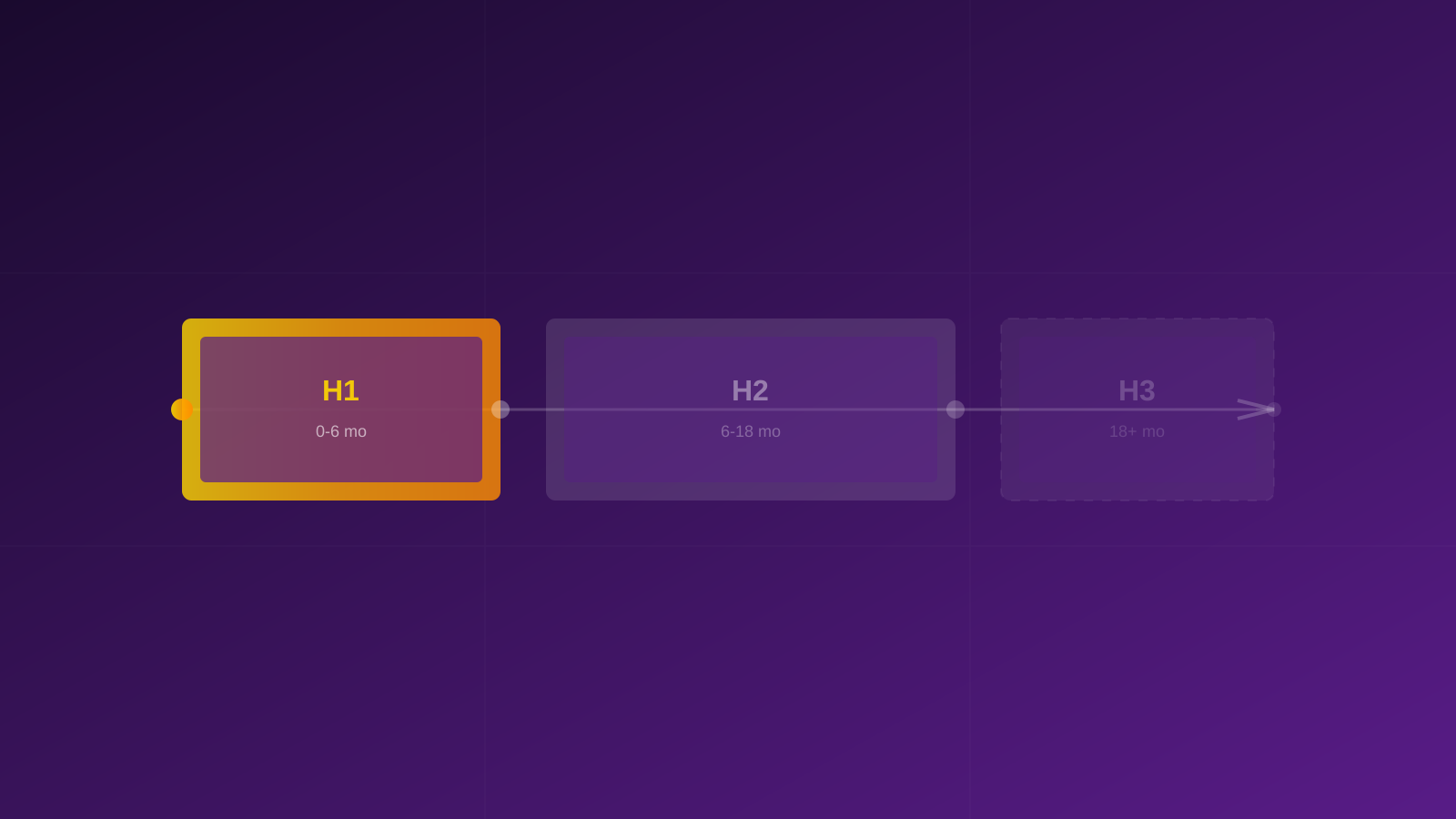
Three horizons: Productivity, Differentiation, Disruption
How to prioritize investment
The framework is useful, but it doesn't tell you where to start. Here's how we help portfolio operations teams make that decision.
Start with the 80/20:
What single workflow, if automated, would return 80% of the potential impact? That's your first bet.
Say an operations team spends 30 hours per week manually reviewing compliance documentation. An AI-powered review system can handle the straightforward cases (the bulk of the volume) and flag edge cases for human review.
The impact: most of those hours return to the business, and the rest go to genuinely complex cases that need human judgment.
That isn't the sexiest AI application, but it is the 80/20 play, maximum impact, minimum complexity.
Map to strategic priorities:
Your portfolio company has 3-5 things that actually matter for the next 12 months, revenue growth, margin expansion, product launch, market expansion, customer retention.
AI investments should map to those priorities. If improving customer retention is the goal, don't automate internal reporting. Build AI capabilities that make customers more successful.
Say a portfolio company's strategic priority is geographic expansion and the constraint is local language support. AI-powered translation and localization built into the product isn't an operations play, it's a strategic enabler that unblocks a growth vector.
The investment made sense because it directly served the priority.
Consider organizational readiness:
Some portfolio companies are ready for Horizon 2 investments. Others need to prove out Horizon 1 before they have organizational buy-in for bigger bets.
If leadership is skeptical about AI, start with a small Horizon 1 win. Build credibility through results, then expand.
If leadership is already bullish and you have engineering capacity, skip straight to Horizon 2. Don't waste time on incremental improvements when you could be building differentiation.
We've seen both approaches work. The failure mode is mismatching ambition to readiness, trying to transform a skeptical organization leads to stalled projects, while being too cautious in an organization ready to move leads to missed opportunity.
AI SANITY CHECK
Where does your AI maturity actually stand?
Take our 2-minute diagnostic and get a personalized AI maturity assessment with a 30-day action plan.
Take the AI Sanity CheckWhat this actually costs (market ranges)
The question we hear most from PE operators: "What does this actually cost to implement?"
Honest answer: It depends on the complexity, the existing tech stack, and whether you build or buy.
Based on implementations we're tracking across the market, here's what we're seeing:
Horizon 1 implementations:
Market range is $10K-75K for a focused productivity play. This includes discovery, implementation, and basic training. Timeline is 4-12 weeks depending on integration complexity.
Horizon 2 differentiation plays:
Market range is $100K-500K depending on scope. This is custom development work that becomes part of your core product. Timeline is 3-6 months for initial version, plus ongoing iteration.
Horizon 3 transformation:
Market range is $1M+ and 12-18 months. This is rebuilding significant portions of the business. Not recommended unless you're building a platform or it's a pre-exit value creation play.
For context, run the math on a focused productivity play. If an implementation returns a couple hundred hours a month of operations capacity, then at typical loaded costs for operations staff the monthly capacity value can exceed the one-time implementation cost within a couple of months.
That's the kind of math that makes operators pay attention.
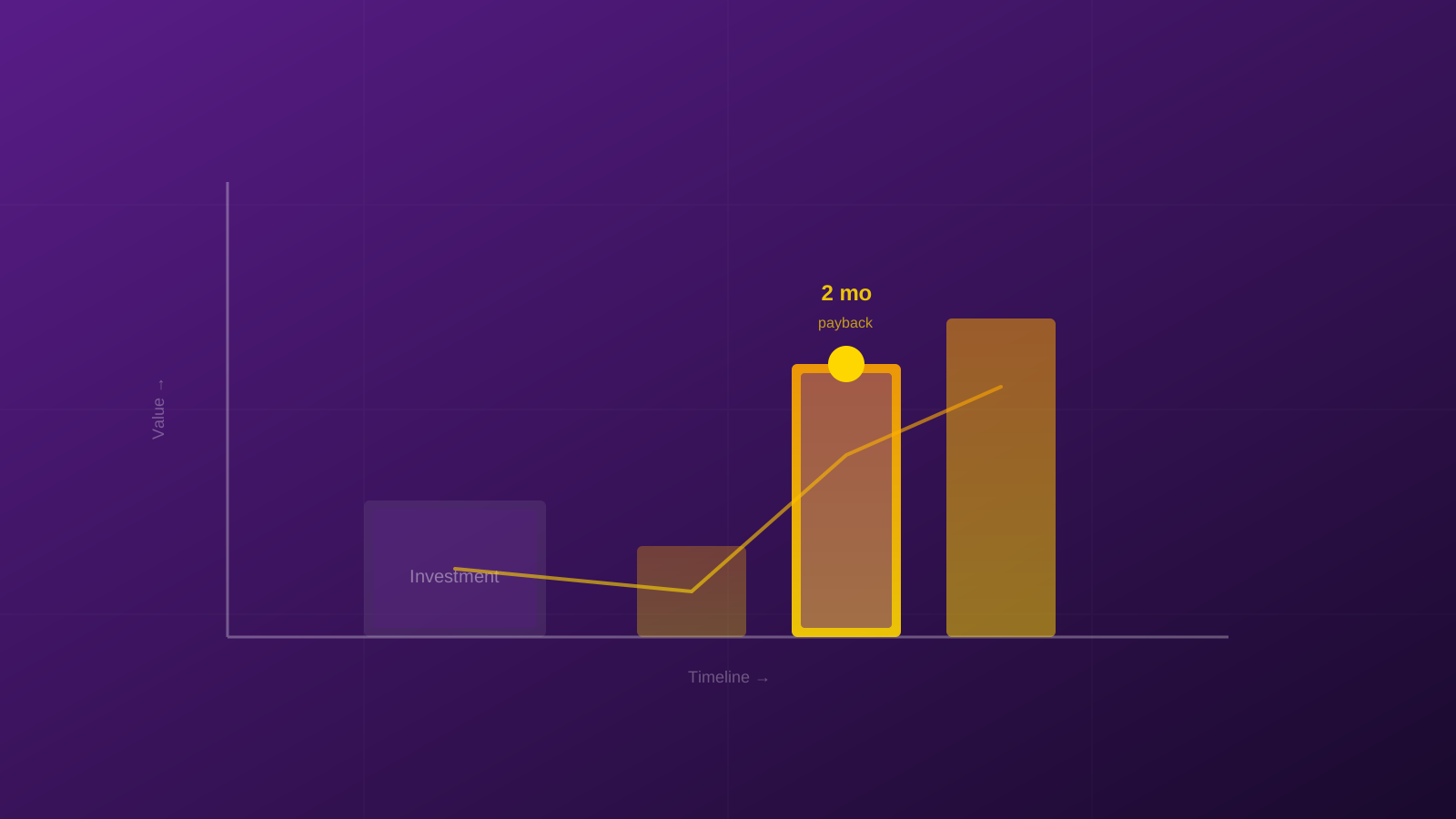
Real ROI: 2-month payback typical for Horizon 1 plays
The common mistakes we see
After working with a dozen portfolio companies on AI implementations, the failure patterns are predictable. Honestly, most teams make the same five mistakes.
Mistake 1: Optimizing the wrong thing:
We see teams spend six figures automating processes that don't move the business forward. The automation works perfectly, it just doesn't matter.
Before you invest in AI, get ruthlessly clear on what actually matters. If it's not in your top three priorities, don't automate it yet.
Mistake 2: Buying tools without strategy:
Portfolio companies buy AI tools because they sound useful, Copilot for coding, Jasper for content, Perplexity for research. The tools sit unused because no one defined the workflow change required to adopt them.
Tools are downstream of strategy. Figure out what you're trying to achieve first, then choose tools that serve that goal.
Mistake 3: Underinvesting in implementation:
The software license is often one-fifth of what implementation actually costs. Teams balk at the implementation investment and try to do it internally with no capacity.
Six months later, nothing's shipped.
Implementation matters more than the tool. Budget accordingly.
Mistake 4: Expecting AI to fix process problems:
AI can't fix broken processes, it can only accelerate them. If your workflow doesn't work manually, automating it just means failing faster.
Fix the process first, then use AI to scale it.
Mistake 5: No ownership:
AI projects without clear ownership die. Someone needs to own the outcome, not just the implementation. That person needs authority to make decisions and capacity to drive adoption.
We've seen great implementations fail because no one owned making sure the team actually used it.
A practical playbook for portfolio operators
If you're a portfolio operations team looking at AI for the first time, here's the playbook we recommend:
Quarter 1: Assess and pilot:
Pick one high-impact Horizon 1 opportunity, something that's genuinely painful and has clear ROI. Spend 4-8 weeks implementing it. Track the results rigorously.
The goal isn't to transform the company; it's to prove that AI can deliver tangible value quickly. You're building organizational confidence for bigger bets later.
Quarter 2: Scale what works:
If the pilot worked, expand it. If it didn't, learn why and try something else. Either way, you now have data instead of hypotheses.
This is also when you start looking at Horizon 2 opportunities. What could we build that would differentiate the business, not just improve operations?
Quarter 3-4: Differentiation play:
With Horizon 1 wins proven out, make a bigger bet on Horizon 2. This is a 3-6 month initiative that builds AI capabilities into the core product or service.
Success here looks like customers choosing you because of the AI capability, margin expansion through reduced service costs, or revenue growth from new product lines enabled by AI.
Year 2: Strategic scaling:
By year two, AI should be embedded in how the company operates. New workflows assume AI capabilities. Product roadmaps include AI features. The organization has capacity to evaluate and adopt new AI tools as they emerge.
This is when you might consider Horizon 3 investments if they align with exit strategy.
What we're seeing work right now
Based on implementations across portfolio companies in the past six months, here are the plays showing consistent ROI:
- Customer support automation: 40-60% of support volume can be handled by AI without quality degradation. The remaining 40-60% gets faster human response because the queue is smaller.
- Document processing: Extracting data from PDFs, contracts, invoices, and forms. Accuracy exceeds manual review and speed is 100x faster.
- Meeting intelligence: Transcription, summarization, action item extraction. Returns 2-5 hours per week per knowledge worker.
- Data analysis: AI-powered analytics that make data accessible to operators without requiring SQL or BI tool expertise. Dramatically increases data utilization.
- Workflow automation: Process orchestration that removes manual handoffs between systems. Reduces cycle time and error rates.
- Content generation: Marketing copy, documentation, email responses. Not replacing writers, but making them 3-5x more productive.
All of these fall into Horizon 1. All show positive ROI within 90 days. All can be implemented in 6-12 weeks.

6 proven plays delivering ROI within 90 days
The real opportunity
Here's the reality, the portfolio companies winning with AI aren't doing anything magical. They're just moving faster than their competitors and making smarter bets about where to invest.
They start with operational efficiency to build confidence and free up capacity. They use that capacity to build differentiation. They use differentiation to expand margins or grow revenue.
The companies that wait are falling behind. Not because AI is magic, but because the operational leverage is real. A 10-person operations team with AI tools can outperform a 20-person team without them. A product with AI-powered features can charge 30% more than competitors without them.
That gap compounds.
For PE operators, the question isn't whether to invest in AI, it's whether you're moving fast enough to capture the opportunity before your portfolio companies' competitors do.
Based on what we're seeing across the market, the answer for most operators is no. There's still time to close the gap, but the window is narrowing.
The good news: This isn't a moonshot. You don't need a transformation program or a dedicated AI team. You need one smart bet that delivers tangible value in the next 90 days.
That's enough to build momentum. The rest follows from there.
Want to talk through what this might look like for your portfolio companies? We work with PE operators and portfolio company leadership teams to identify high-ROI AI opportunities and ship them in 6-12 weeks. No lengthy assessments, no transformation roadmaps, just focused bets that deliver measurable value.