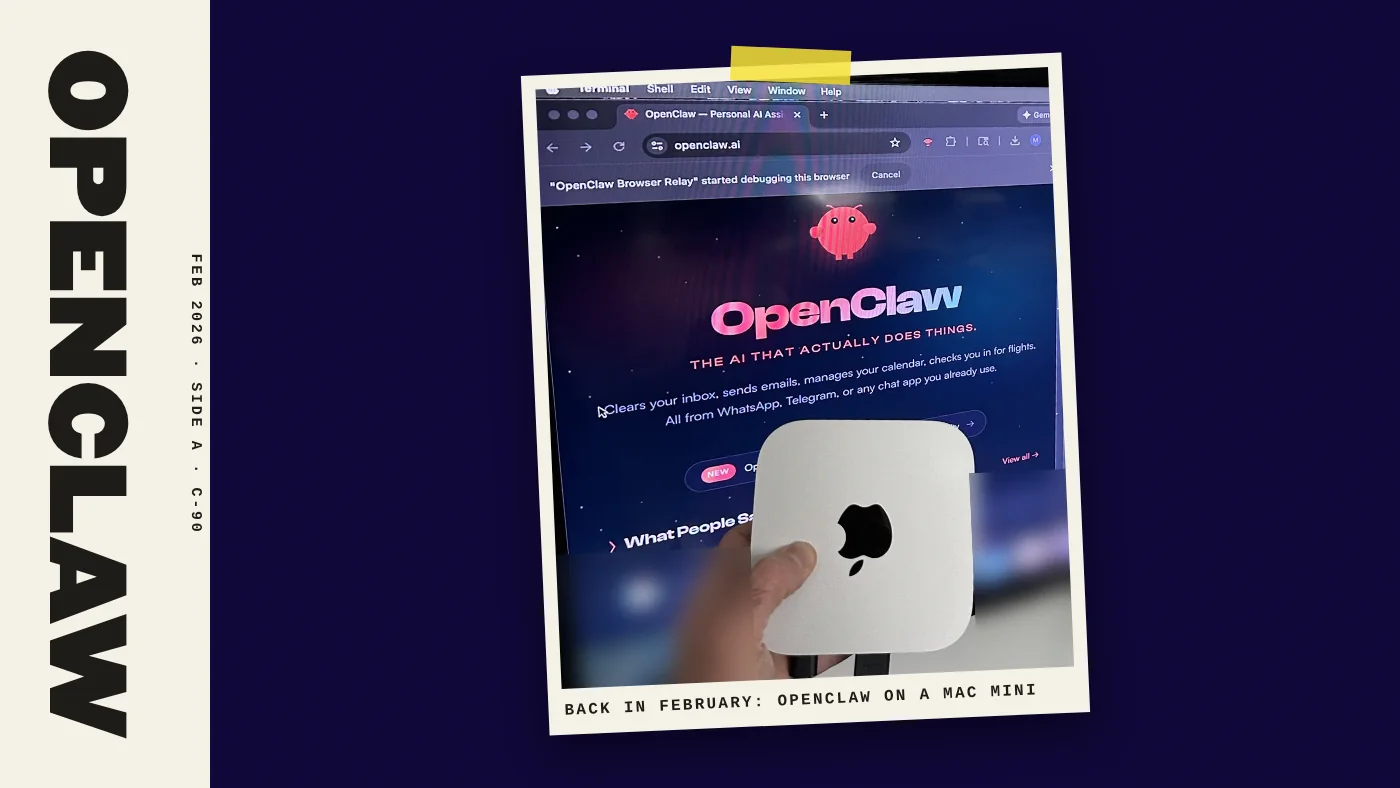
Back in February I sent a text from my phone and watched a Mac mini on my desk open a browser and start clicking around on its own. I sat there stunned. Nine months later, every big AI lab has shipped its own version, and they're all smart. What I care about now is who ends up owning the one that knows everything about you.
This is the first thing I've written since we relaunched stealthx.co on Monday. The site is now built around what we call the 4 stages and 3 frontiers of AI, with a new look to go with it (the cassette labels all through this post are part of it). I'll come back to the stages later, because they explain my own setup better than I expected.
Key takeaways
If you only have a minute, here's what to take from this post.
- Context matters more than the model. Every assistant is smart now. Put structured context in a place you own, so any assistant you try can read it and write back to it.
- Give it its own identity. An assistant that logs in as you can do anything you can do. Give it its own email/accounts/keys from day one.
- Put the guardrails in the keys. Scope each key to what it needs and keep one off switch, so the blast radius stays small on the day it goes wrong.
- Build a dreams loop. Have it run a short retro at the end of each day and propose what it should learn.
- Not for your company's data yet. Try them on personal stuff. For a company, a proactive AI teammate is Stage 4, and the path there runs through the first three stages.
Table of contents
The weekend I set up OpenClaw
That Mac mini was running OpenClaw, which I'd set up the weekend I brought it home. If you missed that wave, OpenClaw (it started as Clawdbot, then Moltbot) is an open source personal assistant that lives on its own machine and runs around the clock. A lot of people were buying Mac minis that month for exactly this.
I'd seen the stories of it going off the rails, so I started small. I gave it its own Apple ID and its own email address, with zero access to our real accounts. It could push things to my wife and me (calendar invites/emails/receipts it organized), but it couldn't read or manage anything directly. I set up a Discord server with a channel per topic, and it felt like talking to a teammate in Slack.
A few things went sideways right away. The Gmail address I made for it got flagged by Google within an hour. And I gave it a token from my Claude Max plan, set the default to Opus 4.6 and watched it burn through half my tokens in under an hour. I switched to routing cheaper models for most of the work and it got a lot more sustainable.
I had Claude help me write it a constitution with scoped access and guardrails, because "Trust is something it earns over time, not something I hand over on day one."
Then came the text from my phone and the browser opening on its own. I'd been building with AI for a while by then, and it was the first time one did real work for me while I watched.
I posted about that weekend at the time. I named it Mr Mayor, after a mascot I designed for Boxybots years ago.
Eventually I shut it down. Keeping it running was more work than it saved, and the token bill kept climbing.
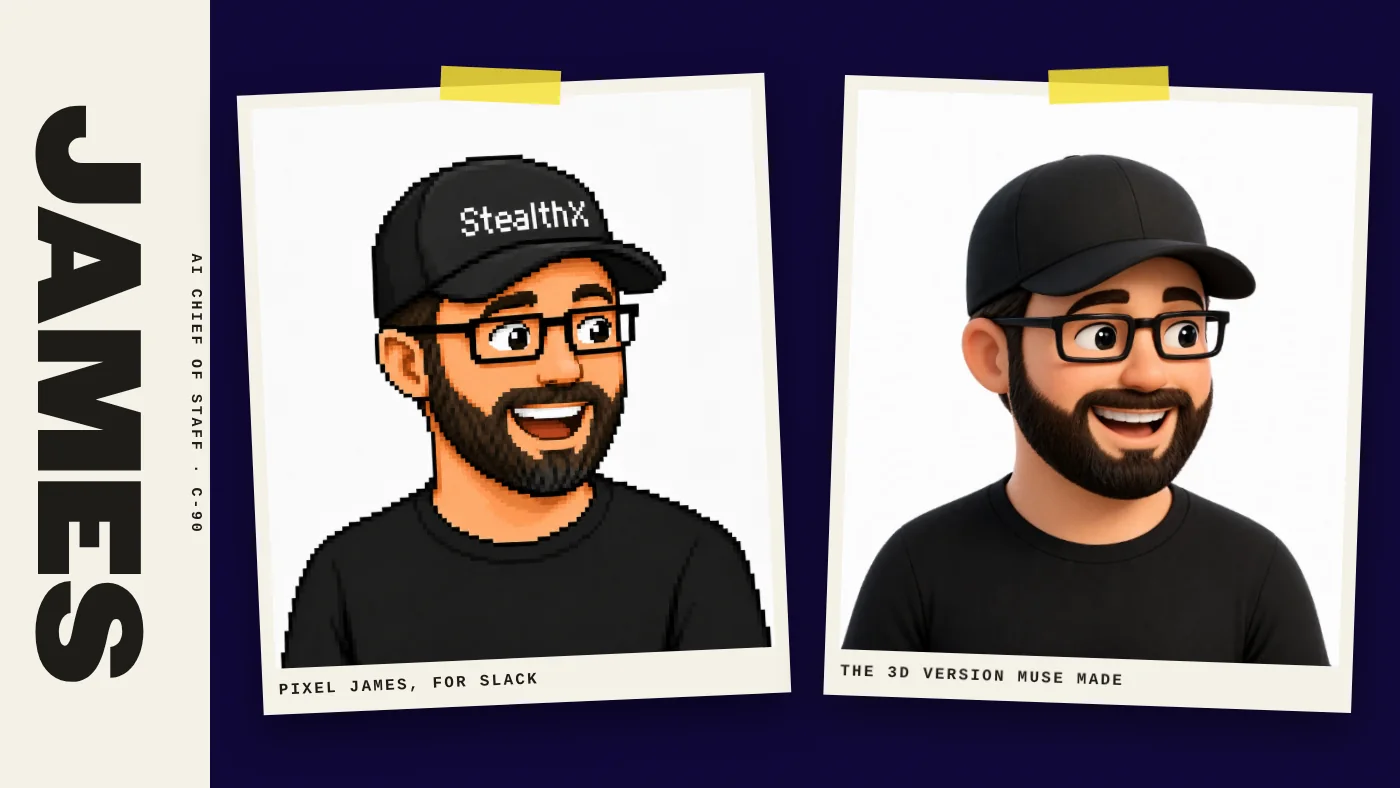
So I built my own: James
Around the same time, I started on James, my AI chief of staff. I've been building him from scratch on the Claude Code SDK since early this year. Some tasks route through OpenRouter to cheaper models when that's the more efficient call.
James is basically a harness plus a context layer. He runs on his own server, on a private network that only my own devices can reach. A heartbeat keeps him looping through transcripts, email and Slack, with clear instructions on what to act on and what to leave alone.
He has his own email address and his own Slack account. He can read my inbox, but he can't send an email as me, because the key he uses doesn't carry send-as. No prompt can talk him into it. Anything he writes goes through a short, fixed list of actions, each one with typed inputs and an undo. And there's a kill switch on my phone that stops every action that would change something until I turn it back off.
We've built trust in tiers. Some things he just does and tells me after. Some things he asks me about first. That list keeps moving as he gets things right.
What James does mostly lands in the first two of what we call the 3 frontiers. He streamlines (the inbox, the morning brief, the follow-ups I'd forget) and he helps me stand out (content and responses that go out faster than I could manage alone). That frees up time and headspace for the third frontier, disrupt, which is where I want to spend more of my week anyway.
About 100 days that made the category
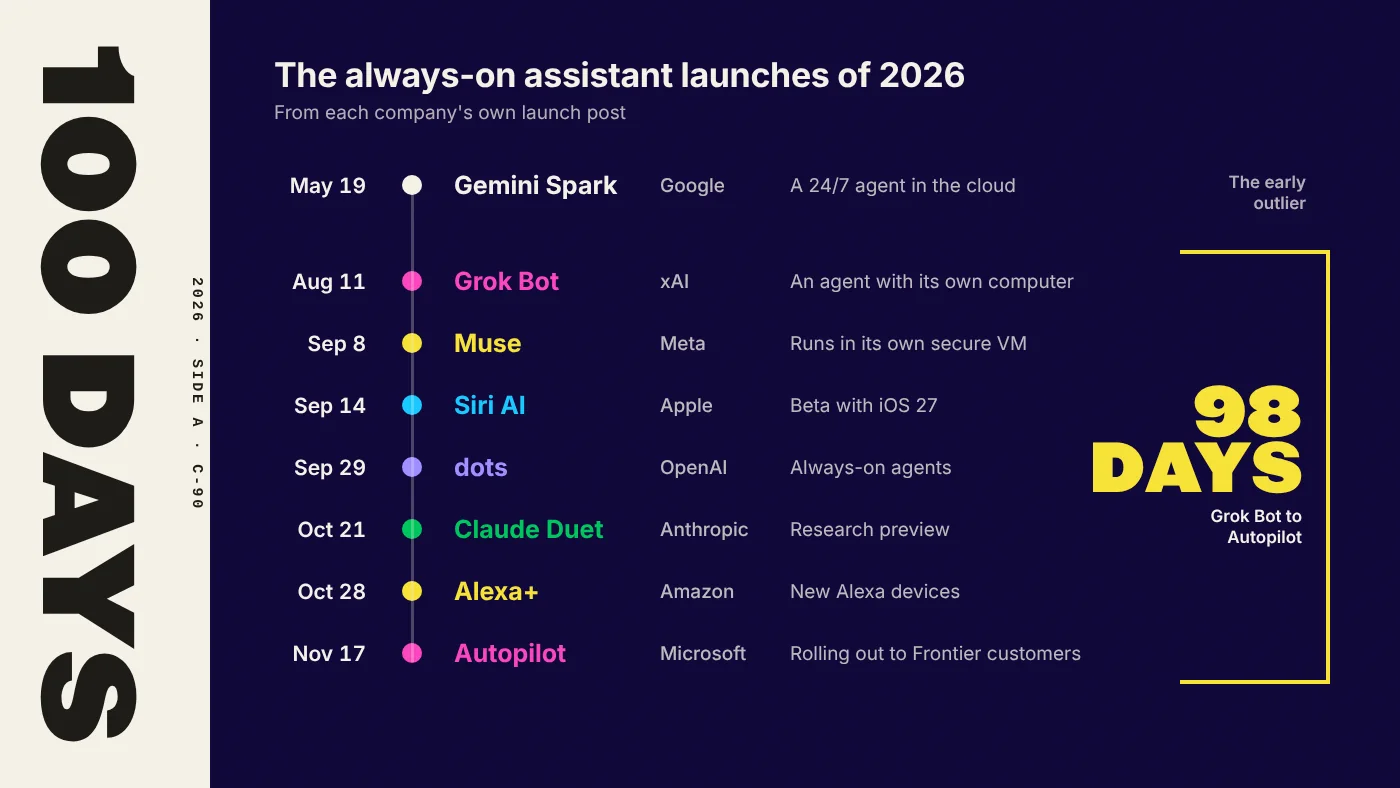
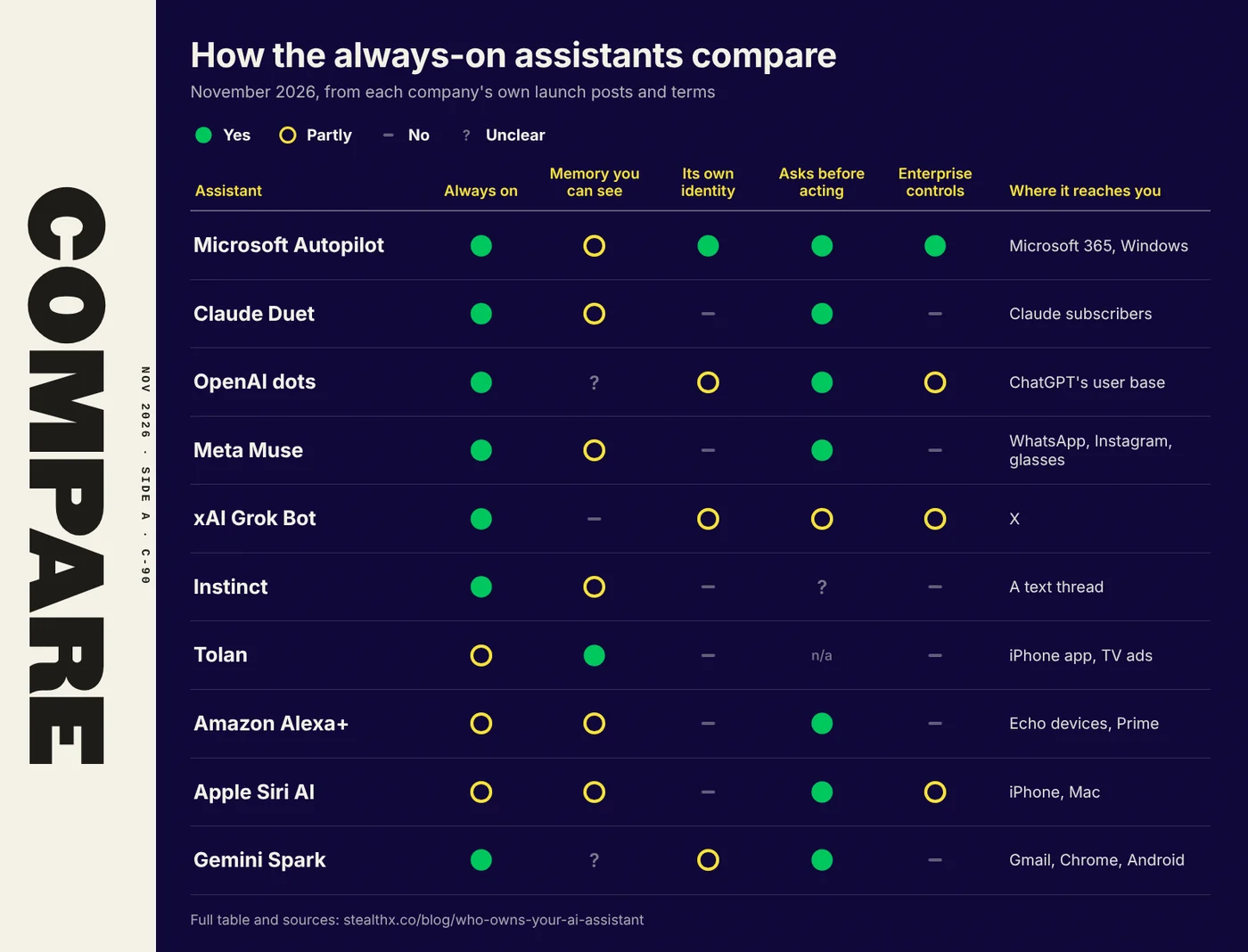
While I was building James, everyone else shipped theirs. From Grok Bot in August to Autopilot rolling out this week was 98 days. The chart below and the full table at the end come from these launch posts and the vendors' own terms.
- May 19. Google introduced Gemini Spark at I/O, an agent that runs 24/7 in the cloud. It was early, and the rest of the pack took the summer to catch up.
- Aug 11. xAI opened an early beta of Grok Bot, an agent with its own computer.
- Sep 8. Meta launched Muse, running in its own secure VM with a Sentinel agent watching over it.
- Sep 14. Apple shipped Siri AI in beta with iOS 27.
- Sep 29. OpenAI introduced dots, always-on agents with their own cloud computer.
- Oct 21. Anthropic released Claude Duet as a research preview.
- Oct 28. Amazon showed its new Alexa devices, with Alexa+ handling multi-step requests.
- Nov 17. Microsoft started rolling out Autopilot, its always-on agent in Copilot, to Frontier customers.
OpenClaw is the common ancestor of a lot of this. Microsoft built Autopilot on it, Grok Bot was pitched as a hosted way to skip running it yourself, and Muse's nightly dreams look a lot like the pattern OpenClaw users were already running.
How they compare
Here's how the always-on assistants compare on 5 things. The full table, with notes and a source for every row, is at the end of the post.
What I've learned using them
So I tried them. I've been running most of these side by side, next to James. The models underneath are all really good, so what I notice is how each one organizes the work once I hand it over.
Duet has clicked for me the most. It has channels, and each one holds a single part of my world (biz dev, content, personal, finance). Inside each channel there's an agent I talk to, plus worker agents off doing tasks in threads. The other morning I was driving and talked through about 15 things I wanted done, and it spun up a worker for each one. It feels like Slack with a teammate. Underneath, it's an orchestrator with a voice, and I've started using it as the voice layer on top of James.
OpenAI's dots is right up there, though one thread gets crowded fast when you hand it 15 things. Muse has the best consumer experience of the big labs. Grok Bot is great for power users who want to spin up lots of bots, and it has a lot of buzz in the AI crowd.
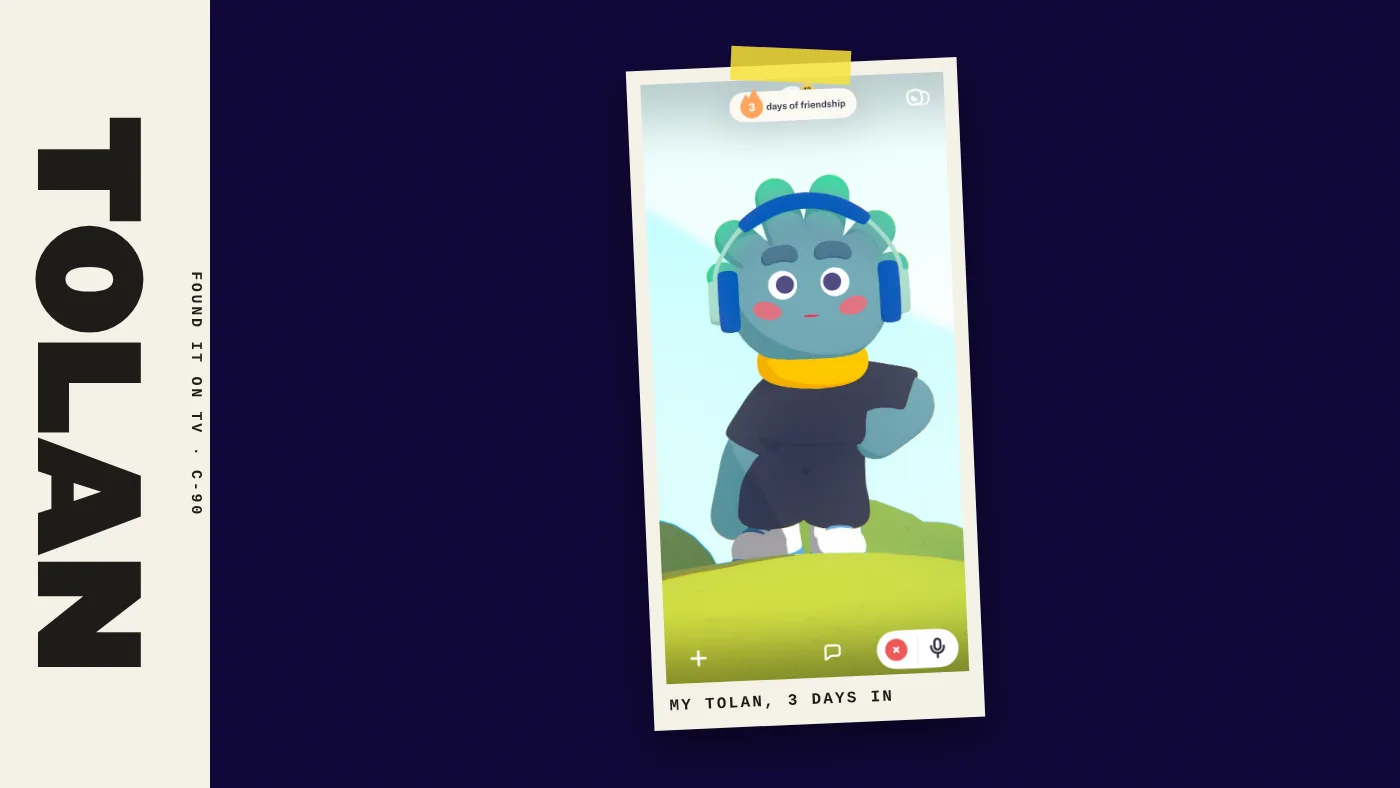
Then there's Tolan, which I didn't find through my usual AI channels at all. I found it through YouTube with my kids, Disney+ with the family and TV commercials I don't normally pay attention to. An Oracle interviews you and matches you with a character (I named mine James, of course). It has a little cottage where your friends' Tolans can hang out, it checks in on you, and you can schedule it to call you. It's buttery smooth, and it's the first one that felt like talking to a friend. Consumer AI has come a long way from Clippy, and this stuff is reaching families before it reaches most of the operators I talk to.
Instinct is an agent you just text, which is simple and it works. But Instinct's terms say what it agrees to on your behalf is "binding on you as if entered into directly by you." Read the terms before you connect anything that matters.
Two things have bitten me. First, a lot of these ship with the governor off. They run constantly because that's what makes them feel magical and keeps you coming back. I had sub-agents looping on my inbox and files, burning tokens all day. I told mine to kill every background process and rebuilt it to look back at the last 24 hours once a day and send me one digest.
Second, fragmentation. Between Duet, Claude on my desktop and phone, coding sessions, James and Codex, I lost track of where I'd started a task. I was walking a teammate through it, and asking one session to find another just spun up more sessions. And every one of those sessions was holding a piece of my context.
2027 AI STRATEGY PLAYBOOK
Plan AI into your 2027 budget.
A 58-page guide for CEOs, COOs and operators at privately held $30M to $500M companies. It includes a 12-question starting-point checklist and a 30/60/90 checklist.
Get our 2027 AI PlaybookSo who's going to own it?
Every one of these gets better the more of your context it has, and that's also what makes it hard to leave. Most of the assistants I use wouldn't let me export their memory when I asked. Muse was the only one that handed over its files and dreams.
It reminds me of No-Face from Spirited Away (the 2001 Studio Ghibli film). He shows up at a bathhouse looking harmless, pays in gold for food, and gets bigger with every meal until he starts eating the workers. We do something similar with the labs. We hand over our context, the gold we get back is real (speed, convenience, everything in one place), and every bit we hand over makes leaving a little harder.
And the labs aren't slowing down. I figured out how I think about them while playing Mario Party on the Switch with my kids. There's a minigame where everyone runs down a lane dodging obstacles while a giant ghost chases you. Clip an obstacle and you slow down. Get caught and you're out. The labs are the ghost. Recently Anthropic released Claude for Manufacturing, a plugin full of skills for drafting quotes, quality reports and supplier requests, and my first reaction was "oh crap," because a lot of it looks like work people are building right now. Personal assistants are the next lane. Stopping is how you get caught, so we keep building.
So who's going to own your AI assistant? I want it to be me. I use Claude every day and it's incredible, and I'll keep using whichever model is best that week. But my context, its identity and its keys stay mine, with a copy outside any one lab, and if the door ever closes it all moves to our own servers and open models.
Whichever one you pick, get these 4 things right
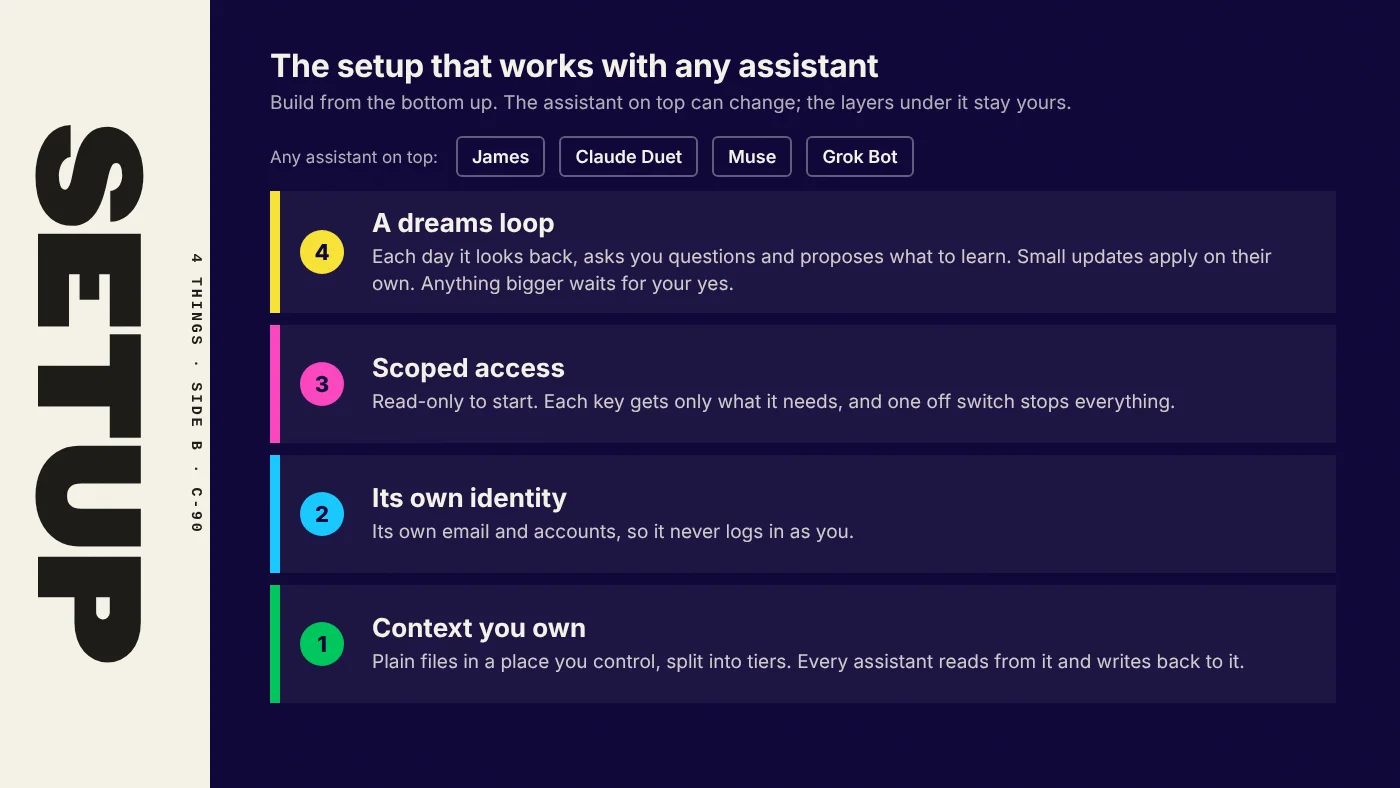
Owning it comes down to 4 things, and they apply to every assistant in the chart.
- 1. Context in one portable place: The assistant that knows the most about you is the one you'll keep using, so decide where that knowledge lives. Mine lives in plain files in a few repos, split into tiers by who should see what. Every assistant I use reads from it and writes back to it. When I dropped a couple of those context files into Muse and Grok Bot, I didn't have to connect my accounts. Each one already knew the drill and became a version of James with less access. We're doing the same thing for the CLT Startup House. Its context lives in a repo with a plugin, so Claude and ChatGPT both work from the same brain.
- 2. Its own identity: Mr Mayor got his own Apple ID on day one, and James has his own email and Slack. Microsoft is heading the same way for companies: "Each Autopilot has its own Microsoft Entra Agent ID and a named manager." Most consumer assistants still act as you, through your connected apps. That's fine for a calendar. I wouldn't do it with email.
- 3. Scoped access and a small blast radius: Ask what happens if it goes wrong, and how far it can reach when it does. Start read-only. Scope every key to what it actually needs. Keep one off switch for everything. Grok Bot's own guide says that if you log into a site with one bot, every other bot can reach that site too, and I wish more vendors said that kind of thing up front.
- 4. A dreams loop: Muse runs dreams at night. Tolan keeps a journal that surfaces things that make you wonder how it knew. My assistants run their own retro at the end of each day. Each one looks back, asks me questions, and proposes what to learn. Low-risk updates apply on their own. Anything bigger waits for my yes. I've been working on a version of this for our human team too: a 3-minute daily retro where each person writes down what the problem was, how they handled it and what the outcome was, so it gets stored as knowledge the whole team can use.
A personal assistant is a mini version of Stage 4 for companies
This is where Monday's relaunch comes in. We rebuilt stealthx.co around the 4 stages of AI because it's the path we see every company on, and a proactive personal assistant is Stage 4, Add AI teammates, showing up on your phone before it shows up at work. The 4 things above are the stages, run on one person:
- Set the direction. I made it a priority, bought a Mac mini and gave up a weekend.
- Lay the foundation. I wrote my context down in a place I own, set guardrails, gave it its own identity and scoped its keys.
- Build your AI operating system. I made one place that every assistant reads from and writes to, so nothing important lives in just one app.
- Add AI teammates. James acts on his own inside the rules, and the dreams loop makes him a little better each day.
I skipped straight to Stage 4 with OpenClaw, and it didn't stick. James works because the first three stages are underneath him. And once he took over the streamline and stand out work, I got time back for the third frontier, disrupt, which is the payoff companies are after too.
Companies are going to hit the same wall I did with OpenClaw. Everyone wants AI teammates doing real work, and the ones that get there will have done the foundation and the operating system first. That's the whole idea behind the 2027 AI Strategy Playbook, if you want a way to figure out where you are.
Where I think it's headed
Stage 4 is where this is all heading, for people first and companies right behind. These are my predictions, with what makes me think so.
- Agents will get IDs. Within 18 months, agents acting for a company will carry a registered identity, and someone will be accountable when one goes off the rails. Microsoft's Entra Agent IDs, NIST's AI Agent Standards Initiative and Cloudflare's signed agents all point that way. Consumers will follow, more slowly.
- Proving you're a real person gets harder. It'll take more than a 2-factor code, and a lot of it will be biometric.
- Agents will say who they act for. Something like "Claude Duet, on behalf of Drew."
- Hardware wins more than people think. Apple and Amazon are the dark horses. My kids are trained on Alexa, and so is my mother-in-law, who doesn't use any other tech. Siri's been behind for a long time, but Apple wasn't first to the tablet either.
- Agents will work with other agents. Your agent will work with mine, and there will be context leaks along the way when someone forgets a guardrail.

Not for your company's data yet
Those context leaks are a big reason I still don't recommend that enterprise or mid-market companies put their data into, or connect their tools to, any of these proactive personal assistants yet. Wait until they mature and there are proper controls, identity and access, and governance in place to protect your IP and your data, and to reduce the risk of security attacks or agents doing things they shouldn't.
You can still get to AI teammates, the same way James did: set the direction, lay the foundation, build your AI operating system, then add AI teammates inside rules your people set. That's the work we do with clients, and it's what the 2027 AI Strategy Playbook walks through.
What I'd do this month
For your own assistant, here's where I'd start.
- Try 2 of them on low-stakes personal stuff. Calendar, research, errands.
- Write your context down in a few plain files you own, then hand those files to each assistant you try.
- Give the one you keep its own email address and accounts.
- Write your tiers down: what it can just do, and what it has to ask about first.
- Scope the keys, start read-only, and keep one off switch.
- Turn the background processes down to a daily digest until you trust it.

The full comparison
Here's the detail behind the chart earlier in the post, with a source for each row.
How they work
| Assistant | Always on | Memory you can see or export | Its own identity | Asks before acting |
|---|---|---|---|---|
| Microsoft Autopilot | Yes | Partly: an audit trail | Yes: an Entra Agent ID and a named manager | Yes, before key actions |
| Claude Duet | Yes: checks in every few hours | Partly: Claude memory is viewable | No: works through your connected apps | Yes: before sending, paying or signing |
| OpenAI dots | Yes | Unclear | Partly: specialist dots in a pilot | Yes: built-in rules for act vs ask |
| Meta Muse | Yes | Partly: files and dreams, on export | No | Yes, plus a Sentinel agent |
| xAI Grok Bot | Yes: routines | No documented export | Partly: its own email address | Partly |
| Instinct | Yes | Partly: a vault, deletion on request | No: legally it acts as you | Unclear, and its agreements bind you |
| Tolan | Partly: check-ins and scheduled calls | Yes: memories | No | Doesn't apply: it doesn't take actions |
| Amazon Alexa+ | Partly: routines and suggestions | Partly: Cards | No | Yes, for purchases |
| Apple Siri AI | Partly | Partly: context stays on device | No | Yes, through apps |
| Google Gemini Spark | Yes: cloud machines 24/7 | Unclear | Partly: its own Gmail address | Yes, before spending or sending |
Microsoft Autopilot
- Always on
- Yes
- Memory you can see or export
- Partly: an audit trail
- Its own identity
- Yes: an Entra Agent ID and a named manager
- Asks before acting
- Yes, before key actions
Claude Duet
- Always on
- Yes: checks in every few hours
- Memory you can see or export
- Partly: Claude memory is viewable
- Its own identity
- No: works through your connected apps
- Asks before acting
- Yes: before sending, paying or signing
OpenAI dots
- Always on
- Yes
- Memory you can see or export
- Unclear
- Its own identity
- Partly: specialist dots in a pilot
- Asks before acting
- Yes: built-in rules for act vs ask
Meta Muse
- Always on
- Yes
- Memory you can see or export
- Partly: files and dreams, on export
- Its own identity
- No
- Asks before acting
- Yes, plus a Sentinel agent
xAI Grok Bot
- Always on
- Yes: routines
- Memory you can see or export
- No documented export
- Its own identity
- Partly: its own email address
- Asks before acting
- Partly
Instinct
- Always on
- Yes
- Memory you can see or export
- Partly: a vault, deletion on request
- Its own identity
- No: legally it acts as you
- Asks before acting
- Unclear, and its agreements bind you
Tolan
- Always on
- Partly: check-ins and scheduled calls
- Memory you can see or export
- Yes: memories
- Its own identity
- No
- Asks before acting
- Doesn't apply: it doesn't take actions
Amazon Alexa+
- Always on
- Partly: routines and suggestions
- Memory you can see or export
- Partly: Cards
- Its own identity
- No
- Asks before acting
- Yes, for purchases
Apple Siri AI
- Always on
- Partly
- Memory you can see or export
- Partly: context stays on device
- Its own identity
- No
- Asks before acting
- Yes, through apps
Google Gemini Spark
- Always on
- Yes: cloud machines 24/7
- Memory you can see or export
- Unclear
- Its own identity
- Partly: its own Gmail address
- Asks before acting
- Yes, before spending or sending
Controls, data and reach
| Assistant | Enterprise controls | Trains on your data | Where it reaches you | Source |
|---|---|---|---|---|
| Microsoft Autopilot | Yes: scope, block and audit | Per Microsoft 365 work terms | Microsoft 365 and Windows | Microsoft |
| Claude Duet | Not yet | Per your Claude settings | Claude subscribers | Anthropic |
| OpenAI dots | Partly: Business and Enterprise | Depends on your plan | ChatGPT's user base | OpenAI |
| Meta Muse | No | Yes, unless you opt out | WhatsApp, Instagram and glasses | Meta |
| xAI Grok Bot | Partly: an enterprise plan since September | Unclear | X | xAI and its guide |
| Instinct | No | Yes, unless you opt out (going forward) | A text thread | Instinct's terms and TechCrunch |
| Tolan | No | Unclear | iPhone app and TV ads | OpenAI case study |
| Amazon Alexa+ | No | Unclear | Echo devices and Prime | Amazon |
| Apple Siri AI | Partly: device management | Apple's privacy model | iPhone and Mac | Apple |
| Google Gemini Spark | No: personal accounts | Per Google's terms | Gmail, Chrome and Android | TechCrunch |
Microsoft Autopilot
- Enterprise controls
- Yes: scope, block and audit
- Trains on your data
- Per Microsoft 365 work terms
- Where it reaches you
- Microsoft 365 and Windows
- Source
- Microsoft
Claude Duet
- Enterprise controls
- Not yet
- Trains on your data
- Per your Claude settings
- Where it reaches you
- Claude subscribers
- Source
- Anthropic
OpenAI dots
- Enterprise controls
- Partly: Business and Enterprise
- Trains on your data
- Depends on your plan
- Where it reaches you
- ChatGPT's user base
- Source
- OpenAI
Meta Muse
- Enterprise controls
- No
- Trains on your data
- Yes, unless you opt out
- Where it reaches you
- WhatsApp, Instagram and glasses
- Source
- Meta
xAI Grok Bot
- Enterprise controls
- Partly: an enterprise plan since September
- Trains on your data
- Unclear
- Where it reaches you
- X
Instinct
- Enterprise controls
- No
- Trains on your data
- Yes, unless you opt out (going forward)
- Where it reaches you
- A text thread
- Source
- Instinct's terms and TechCrunch
Tolan
- Enterprise controls
- No
- Trains on your data
- Unclear
- Where it reaches you
- iPhone app and TV ads
- Source
- OpenAI case study
Amazon Alexa+
- Enterprise controls
- No
- Trains on your data
- Unclear
- Where it reaches you
- Echo devices and Prime
- Source
- Amazon
Apple Siri AI
- Enterprise controls
- Partly: device management
- Trains on your data
- Apple's privacy model
- Where it reaches you
- iPhone and Mac
- Source
- Apple
Google Gemini Spark
- Enterprise controls
- No: personal accounts
- Trains on your data
- Per Google's terms
- Where it reaches you
- Gmail, Chrome and Android
- Source
- TechCrunch
Check out Builders of Charlotte
My co-hosts and I recorded a Builders of Charlotte episode on personal agents that's coming out soon. One of my co-hosts has his dot managing his other bots, and we got into who wins the standard users vs the power users. Subscribe on the Builders of Charlotte YouTube channel so you catch it, and watch our latest with Justin O'Connor on whether your vibe-coded app is ready for enterprise.