StealthX

PODCAST

Building Great Experiences

Our founder Drew Burdick sits down with leaders to discuss building great experiences in the age of AI.

Building Great Experiences Podcast
Date range:
Sort by:

Showing 12 of 47 episodes

The Human Touch in the Age of AI

The Human Touch in the Age of AI

In this episode, Drew sits down with Sal Perez, founder of Totem Wealth Management in Charlotte, to talk about what AI means for client experience. Sal grew up in Orlando, played soccer at Winthrop, started his career at Vanguard, and opened his own firm in 2023. They get into why AI note takers make advisors more present, why clients still want a person to hold accountable, and what a handwritten note from a Tupperware CEO and a Ritz Carlton guest notes system teach about paying attention. They also cover hiring for what can't be taught, how AI helps a team personalize at scale, and why Drew tells clients to work in four to six week bets. Takeaways 1. Don't be scared of what's coming. Be scared of not adapting to it. The advisors AI replaces will mostly be the ones who never tried it. 2. People hire white glove service because they lack the time, the willingness, or the ability. Often it comes down to willingness. 3. When something goes wrong, people want a face to hold accountable. Nobody wants to yell at a trading algorithm. 4. Sal typed a scenario about losing a daughter into Gemini and got back a list of cremation places and lawyers. Big life moments need someone who listens first. 5. Sometimes a client just wants to vent. Feeling heard can move you from vendor to trusted partner. 6. A handwritten note still stands out. Rick Goings, then CEO of Tupperware, wrote one for every deal he closed. 7. Small details build loyalty. The Ritz Carlton tracks guest preferences so a Charlotte FC jersey can be waiting on the bed. 8. Standardize your process so you can hire for what can't be taught. Drew's core four are a high give a shit factor, growth mindset, bias toward action, and good communication. 9. AI can make personal touch scale. Before a call, ask it for three to five personal details about the client. 10. Take your best people and put them in an Iron Man suit. Turning on Copilot isn't enough. You have to teach people how to use it. Chapters 00:00 Cold open: the handwritten note 00:36 Intro to the show and guest 01:10 Sal's background: soccer, Winthrop, Vanguard, starting Totem 03:04 Drew's 2022 story: live AI coaching for wealth advisors 04:53 Getting clients comfortable with AI and whether it replaces advisors 08:30 People buy from people, and note takers for doctors and advisors 10:23 AI as a filter and why people hire white glove service 12:01 Accountability: who do you yell at? 14:11 Listening instead of solving 15:34 Moments that matter and big life events 17:30 Testing Gemini with a loss scenario and Sal's mom the hairstylist 19:45 Curation and investing in relationships 22:24 The Tupperware CEO and the handwritten note 25:42 Jelly Bellies and the Ritz Carlton Mystique system 28:40 Who is doing AI well and hiring for the intangibles 30:56 The core four 33:07 Using AI to personalize at scale 34:36 Staying present with an AI note taker 35:59 The Iron Man suit 37:26 High agency: build the raft 38:56 Why Copilot alone is not a strategy and what AI does to software companies 40:58 Four to six week bets and the betting table 43:30 Good Strategy, Bad Strategy: Blockbuster and Kodak 44:49 Generation or mindset? 47:18 Final takeaways and where to find Sal Connect with Sal https://www.linkedin.com/in/salvadorperez https://www.instagram.com/_salperez/ https://totemwealthmanagement.com Connect with Drew https://www.linkedin.com/in/drewhburdick/ https://stealthx.co/

Oct 3, 2026
Authenticity in the Age of AI

Authenticity in the Age of AI

In this episode, Drew sits down with Brian Lafontaine, a working actor of over 30 years turned executive coach, to explore what actually differentiates a person or a brand once AI can produce a flawless email, pitch, or blog post in seconds. The conversation covers why two recent job candidates tried interviewing using an AI avatar, why vulnerability builds more trust than polish, and how founders can use acting techniques like eye contact and presence to connect authentically with customers and teams. Brian shares insights from coaching executives, authors, and entrepreneurs, plus a look inside Speakeasy, the storytelling event he runs monthly in Charlotte. Takeaways 1. Presence cannot be faked or replicated by AI, it only happens in the room in real time. 2. The imperfections and quirks people try to hide are often what make them the most relatable. 3. Trust is earned through connection, not through polish. 4. The cost of real connection is risk, and that risk is what makes it worth something. 5. Attention gets all the credit, but presence is what actually builds trust. 6. The things that do not scale, like one on one conversations, will become the most valuable thing a business offers. 7. Story connecting means linking someone's personal origin story to their professional identity. 8. Building in public brings customers into the journey and builds buy in before the product is even finished. 9. Naming your own nervousness out loud actually makes people trust you more, not less. 10. AI has no stakes. Humans have everything to gain and lose, and that is what makes the human experience worth having. Chapters 00:00 Cold open: "AI has no stakes" 01:04 Intro to the show and guest 01:58 Brian's background as a working actor 02:37 Origin story: from stand up comedy to his first stage role 03:52 Movies and shows: Ozark, Stranger Things, Dawson's Creek 04:51 Drew's Banshee audition story 06:00 Topic kickoff: authenticity in the age of AI 06:06 The AI avatar job interview story 08:04 Why presence cannot be faked 10:38 Drew's own story: the T shirt brand he used to hide 12:38 Trust is earned through connection 14:05 The sea of sameness 15:51 The price of connection is risk 18:31 Attention vs presence 19:38 Why the things that do not scale matter more 24:00 Listening to understand vs listening to respond 25:10 Who benefits most from this work 29:14 The Mount Rushmore strategy and personal brand 31:25 Building in public 33:07 Why people like to see the struggle 35:15 Brian coins "story connecting" 36:13 What Speakeasy actually is 39:35 The eye contact exercise 45:44 Practical tips for showing up 53:56 Be where your feet are 57:12 Naming the elephant in the room 1:01:11 Wrap up and tying back to the show 1:01:58 Where to find Brian and Speakeasy Connect with Brian https://www.linkedin.com/in/brian-lafontaine/ https://brianlafontaine.com Connect with Drew https://www.linkedin.com/in/drewhburdick/ https://stealthx.co/

Sep 17, 2026
AI in schools - Interview w/ Tory Thompson

AI in schools - Interview w/ Tory Thompson

In this episode, Drew sits down with Tory Thompson, Head of School at Elysium School of Innovation — a hybrid micro school in Huntersville, NC. Students are in the classroom two days a week, learning remotely two days, and out in the world on "field experience" Fridays, at a 10:1 ratio. Tory's path to running a school started with her own son: one of the brightest kids she knew, quietly failing fourth grade in a traditional classroom. When the hybrid program that turned him around got shut down, she built her own. Tory and Drew get into what education actually looks like in the age of AI — not as a threat to be managed, but as the first real chance to teach every kid at their own level. The conversation explores: - Why the problem isn't the kids or the teachers, it's the architecture — a system designed for the industrial revolution - Guardrails vs. barriers: the three layers of protection Tory uses at home and at school, and why blocking everything is the wrong instinct - Cognitive amplifier vs. cognitive offload — and how to tell which one your kid is actually doing - Why the student who hacked the school iPad got praised instead of punished - How testing has to change: "I know you're going to use AI. Now tell me what questions you asked and where they took you." - Financial literacy, entrepreneurship, and real-life skills — a sixth grader researching mutual funds instead of writing another book report - Why AI won't replace teachers, but teachers who refuse to use it will be outdated - Protecting childhood: the two-hour screen limit, family time as a feature, and "this is their one childhood and my one motherhood" If you're a parent trying to prepare your kids for a world that's changing faster than the curriculum, or an educator trying to figure out where AI actually fits, this one is worth your time. Chapters 00:00 Intro: what a hybrid micro school actually is 02:05 Tory's path: teacher, tutoring company, four kids 04:20 COVID, homeschooling, and a bright kid struggling in kindergarten 06:43 Finding Ripple: the hybrid program that changed everything 09:06 From failing fourth grade to the top 9% in the state 11:22 The program gets cancelled, so she builds her own school 13:39 Field experiences, scholarships, and why cost shouldn't decide 15:52 4,000 missing middle school seats and the rise of the hybrid model 17:20 Socrates hated writing: every new tool starts out as a threat 18:17 AI as the great equalizer 20:38 Foundations first: hallucinations and verifying the source 22:57 What guardrails actually look like: router, device management, age settings 25:09 "He hacked the game I made him" — the skills we're afraid of 27:32 Tech literacy, trust, and pulling an app that crossed a line 29:48 Protecting childhood and giving family time back 32:02 Progress over perfection: no grades, and 1.5x growth in three months 34:24 Teaching financial literacy: lemonade stands, mutual funds, and Gemini 36:32 Learn by teaching, and the real-life skills school skips 39:01 "The valedictorian is often just the best cheater" — rethinking testing 43:43 AI won't replace teachers, but it will outdate the ones who ignore it 46:00 Scaling micro schools: 240 kids, then open another one 48:19 Mayberry: community, cell numbers, and being known 50:36 The "Age of Innovation": the stuff we wish we'd been taught 55:14 700 reports in an hour: amplify, don't offload Connect w/ Tory & Elysium School of Innovation https://www.linkedin.com/in/tory-thompson/ https://elysiumschools.org Instagram: @elysiumschools Connect w/ Drew & StealthX https://www.linkedin.com/in/drewhburdick/ https://stealthx.co
Sep 2, 2026
Psychological safety in the age of AI

Psychological safety in the age of AI

In this episode, Drew sits down with Ellie Holbert, Founder and Principal of Impact Advisory Services, to explore why psychological safety has become the most critical leadership skill in the age of AI. The discussion covers the neuroscience behind fear and performance, why 47% of employees can't explain their own job responsibilities, and how leaders can create high-performing teams even when uncertainty is at an all-time high. Ellie shares insights from advising executives at organizations of all sizes, including a case study where an underperforming team unlocked $4.5 million in value through foundational team architecture work. Takeaways 1. When we operate from fear, our amygdala takes over and our strategic thinking goes offline. 2. Only 47% of employees can confidently explain what they're supposed to do in their job. 3. Psychological safety isn't about comfort—it's about enabling informed risk-taking and innovation. 4. Leaders cast a shadow; teams constantly scan for nonverbal signs of displeasure and self-censor accordingly. 5. Pixar's Brain Trust model proves that honest feedback delivered with respect drives exceptional work. 6. The basics are overlooked because they seem too foundational—but role clarity alone can transform performance. 7. Emotional regulation is a learnable skill, not a personality trait. 8. Deep breaths held at the top of the inhale activate your vagus nerve and calm your nervous system. 9. Leaders need to ask for feedback 7+ times before people feel safe enough to share honestly. 10. AI can serve as a stepping stone to coaching—not a replacement for human connection. Chapters 00:00 Introduction to Ellie Holbert and Impact Advisory Services 02:55 Ellie's Journey: From Management Consulting to Entrepreneurship 04:14 Why Psychological Safety Matters More Than Ever 06:22 Above the Line vs Below the Line Thinking 08:07 High Agency Teams and Creating Safe Environments 10:10 The Hidden Cost of Repeated Mistakes 16:11 Pixar's Brain Trust: A Model for Psychological Safety 19:29 Practical Advice for Mid-Size Companies 24:18 After-Action Reviews and The Culture Code 29:10 Top 3 Things Every Executive Should Do 34:13 Using AI as a Coaching and Regulation Tool 40:48 The Future of Work: Why Human Skills Matter More 45:12 Case Study: From 2.4 to 4.8 Team Effectiveness 47:30 Where to Find Ellie and the Team Effectiveness Assessment Connect with Ellie & Impact Advisory Services ⁠https://www.linkedin.com/in/ellieholbert⁠ https://teameffectivenessdiagnostic.scoreapp.com/ Connect with Drew & StealthX ⁠https://www.linkedin.com/in/drewhburdick⁠ ⁠https://stealthx.co/

Mar 18, 2026
AI is killing SaaS

AI is killing SaaS

In this episode, Drew sits down with Brett House, founder and CEO of High Signals, and Rio, leader of advertising and ad tech at Cradera (OmniCom), to explore how AI is fundamentally reshaping go-to-market strategy, customer experience, and the future of software. The discussion covers GTM compression, synthetic data for buyer simulation, the agentic commerce debate, and what happens when AI agents start making buying decisions on our behalf. Drew shares how he built a custom CRM with Claude Code and cancelled HubSpot, and the three unpack why "English is the next coding language." Brett and Rio also host Signal & Noise, a podcast covering ad tech and martech trends. Takeaways 1. GTM cycles are compressing from months to days thanks to AI-powered decisioning. 2. Synthetic data and simulated focus groups can now test at scale faster than traditional methods. 3. Best product doesn't always win. Best marketing and founder-market fit wins. 4. Agentic commerce is coming, but the timeline is debated. Brett is skeptical, Rio is bullish. 5. AI agents will eventually make buying decisions based on ROI per token usage. 6. You can build a functional CRM with Claude Code and cancel your SaaS subscriptions. 7. The concept of a "power user" is dying. AI-native software won't need 50 knobs and controls. 8. English is the next coding language. You don't need to write Python to build tools. 9. Leaders should delegate everything possible to AI first, then focus on decisions only they can make. 10. Think of go-to-market as an operating system, not just messaging. Align product, marketing, sales, and customer success around one playbook. Chapters 00:00 Teaser: I Cancelled HubSpot 00:01 Introduction to Brett House and Rio 01:22 Rio's Origin Story: Journalism to Ad Tech 05:04 Brett's Origin Story: Comp Lit Major to Founder 10:23 Trends in GTM, Ad Tech, and Martech 12:38 GTM Compression: From Months to Days 17:27 Synthetic Data is Actually Good Now 19:19 Best Product Doesn't Win, Best Marketing Wins 24:06 Agentic Commerce: Will AI Agents Buy for Us? 26:16 Brett Pushes Back on Agentic Commerce 29:21 Rio Disagrees: We'll Get Comfortable Over Time 30:18 I Cancelled HubSpot After Building a CRM with Claude Code 35:35 The Death of the Power User 40:33 My COO Agent Built a Dashboard Without Being Asked 42:53 English is the Next Coding Language 43:38 Brett's Advice: GTM as an Operating System 45:36 Rio's Advice: Delegate to AI First 49:11 Where to Find Brett and Rio Connect with Brett & High Signals https://www.linkedin.com/in/bretthouse/ https://www.highsignals.com Connect with Rio https://www.linkedin.com/in/riolongacre/ Signal & Noise Podcast https://open.spotify.com/show/signalnoise https://podcasts.apple.com/us/podcast/signal-noise Tweet Referenced in This Episode https://x.com/flynnjamm/status/2023465136204419096 Connect with Drew & StealthX https://www.linkedin.com/in/drewhburdick/ https://stealthx.co/

Mar 4, 2026
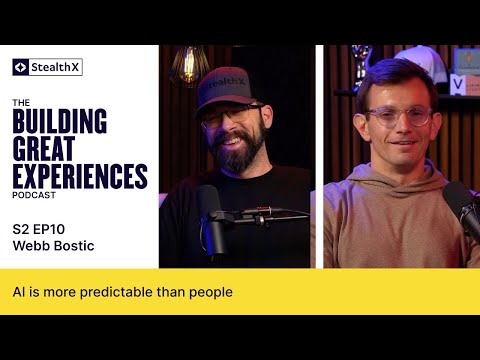
AI is more predictable than people

AI is more predictable than people

In this episode, Drew sits down with Webb Bostic, President and CEO of MessageBridge, to explore the evolving landscape of business text messaging and what happens when AI becomes the gatekeeper to your customers. The discussion covers the SMS ecosystem from carriers to platforms, the difference between good and bad text experiences, the upcoming RCS protocol shift, and a thought-provoking look at a future where AI agents screen messages before humans ever see them. Webb shares insights from building messaging platforms for B2B companies and advocacy organizations, and offers practical advice for businesses looking to leverage text as a strategic channel. Takeaways 1. Text messaging remains the most direct channel to reach customers in the US market. 2. 98% of Americans own a phone and over 90% read texts within minutes. 3. The US is unique—SMS dominates here while WhatsApp and WeChat lead globally. 4. There's a right way and wrong way to use text messaging for customer engagement. 5. Trust must be established before jumping into sales or marketing sequences. 6. RCS (Rich Communication Services) is rolling out and will make SMS feel like iMessage. 7. AI agents will soon act as intermediaries, screening texts before humans see them. 8. AI is actually more predictable than humans—this creates new opportunities. 9. Businesses need to learn from their messaging data to stay ahead of these shifts. 10. Text messaging should be treated as a strategic channel, not an afterthought. Chapters 00:00 Introduction to Webb Bostic and MessageBridge 02:49 Webb's Journey: From Bandwidth to Building Messaging Platforms 05:10 Why Text Messaging is Underrated in Business 06:43 The US Market: Why SMS Still Dominates 08:07 The Threat: Don't Let Text Become the Next Email 10:00 Good vs Bad Text Experiences: The Doctor's Office and Daniel 14:15 Building Trust Through Text: Permission-Based Outreach 17:10 The SMS Tech Stack Explained: Carriers, Platforms, and Tools 24:00 AI Agents as Intermediaries: The Future of Messaging 32:41 When Siri Screens Your Texts Before You See Them 37:00 The Flip Side: AI is More Predictable Than Humans 41:27 How Businesses Should Prepare for AI Gatekeepers 44:30 Practical Advice: Getting Started with Text Messaging 48:00 Where to Find Webb and MessageBridge Connect with Webb & MessageBridge https://www.linkedin.com/in/webb-bostic-a761b113/ https://www.messagebridge.com/ Connect with Drew & StealthX https://www.linkedin.com/in/drewhburdick/ https://stealthx.co/⁠

Feb 13, 2026
AI is Changing Higher Ed

AI is Changing Higher Ed

In this episode, Drew sits down with Michael Trivette, Co-Founder of College Transitions, to explore the evolving landscape of higher education in the age of AI, focusing on the role of College Transitions in guiding students through the college admissions process. The discussion highlights the importance of liberal arts education, the impact of AI on job markets and college admissions, and the significance of building relationships and brand equity in education. The speakers share insights on tools and resources available for students and offer advice on navigating the college experience successfully. Takeaways 1. Higher education is adapting to the challenges posed by AI. 2. Liberal arts education is becoming increasingly valuable in a tech-driven world. 3. Students should remain open to changing their career paths as they explore their interests. 4. Building relationships and brand equity is crucial for educational institutions. 5. AI tools are being integrated into college admissions processes. 6. The Common App streamlines the college application process for students. 7. Students should focus on finding schools that align with their values and goals. 8. Engagement on campus is key to a fulfilling college experience. 9. The landscape of college admissions is changing rapidly due to technology. 10. Long-term investments in brand equity can yield significant benefits for educational organizations. Chapters 00:00 Introduction to College Transitions and AI in Education 02:42 Michael's Journey: From Broadcasting to Higher Education 05:30 The Impact of AI on Higher Education 08:21 The Role of Liberal Arts in a Changing Job Market 11:01 Adapting to AI: Universities' Response 13:49 Embracing AI in College Admissions 15:33 Navigating the Changing Landscape of Education 18:22 Adapting to AI in Education 21:04 Building Brand Equity in a Competitive Market 26:48 The Importance of Long-Term Thinking 30:22 Highlighting Successful Innovations in Education 32:03 The Evolution of College Application Platforms 36:45 Navigating the College Admissions Landscape 43:13 The Role of AI in College Admissions 46:37 Embracing the College Experience Connect with Mike & College Transitions ⁠https://www.linkedin.com/in/michaeltrivette/⁠⁠ https://www.collegetransitions.com/⁠ Connect with Drew & StealthX ⁠https://www.linkedin.com/in/drewhburdick/⁠⁠ https://stealthx.co/⁠

Dec 22, 2025
Guiding, Not Informing

Guiding, Not Informing

In this episode, Drew sits down with Rob Horton, Senior Vice President of Brand and Digital at the YMCA of Greater Charlotte, to explore the future of customer experience, modern marketing, and how AI is reshaping personalization. Rob’s background spans iconic CPG brands (Nestlé, Coca-Cola), a decade in architectural coatings, agency leadership, and economic development—before stepping into a mission-driven marketing role at one of Charlotte’s most community-rooted organizations. That breadth gives him a uniquely sharp understanding of what today’s consumers actually expect: clarity, relevance, guidance, and meaningful human connection. Drew and Rob unpack the Y’s modernization efforts—Salesforce, Marketing Cloud, first-party data, and personalized onboarding and discuss the broader shifts happening across marketing as AI accelerates. They dive into why “guide, don’t inform” is becoming a foundational principle, how brands should blend analog and digital moments, and what leaders should focus on to stay competitive. What you’ll learn in this episode 1. Why “guide, don’t inform” is the new CX mandate 2. How to use personalization without losing authenticity 3. How the YMCA is modernizing CRM, journeys, and member experiences 4. How mid-sized companies should rethink CRM and retention 5. Why emotional connection creates durable differentiation 6. Where AI and agentic experiences fit into future marketing 7. Best-in-class examples from Amazon, Equinox, and Disney 8. How to connect analog human moments with digital intelligence 9. Why being obviously human is now a competitive advantage 10. Practical tactics for ICP sharpening, messaging clarity, and CX strategy Chapters [00:00] – Rob’s Origin Story & Career Arc [03:40] – B2B vs. B2C & the Thread Across All Marketing [05:45] – The Future of Experience: Guide, Don’t Inform [08:00] – Personalization 2.0: From Segments to Individual Journeys [12:25] – Modern CRM: Salesforce, Marketing Cloud & Retention Intelligence [18:25] – Best-in-Class Personalization Examples [20:30] – The Analog/Digital Intersection [27:20] – Human Touch vs. AI Automation [29:35] – Practical Advice for Mid-Market Leaders [37:55] – Final Lessons & Where to Connect with Rob Connect w/ Drew & StealthX LinkedIn: ⁠https://www.linkedin.com/in/drewhburdick/ Website: ⁠https://stealthx.co/ Connect w/ Rob Horton LinkedIn: https://www.linkedin.com/in/rob-horton8120/

Dec 3, 2025
The rise of AI-forward engineering

The rise of AI-forward engineering

In this episode Drew sits down with Justin O’Connor, AI leader at KPMG Advisory and founder of InfraCodebase, an AI-native platform reimagining developer experience and cloud delivery. From automating his first enterprise workflow out of pure frustration to now shaping agent strategy for one of the world’s largest consultancies, Justin’s career has been a masterclass in momentum, experimentation, and enabling people to work smarter with AI. Together, Drew and Justin explore what makes a “10x developer” in the age of agents, how culture—not technology—is the biggest barrier to AI adoption, and why developer experience is fast becoming a competitive advantage. What you’ll learn in this episode 1. Why developer experience is the new differentiator for AI-era engineering teams 2. How to go from “AI curiosity” to real momentum through small wins and prototypes 3. Why culture, literacy, and empathy matter more than tooling when adopting AI 4. How InfraCodebase is rethinking cloud delivery around AI-native collaboration 5. The rise of agents, interoperability, and the coming “year of orchestration” 6. Why SaaS isn’t safe and how AI-native startups can still disrupt crowded markets Chapters [00:00] Justin on AI-native vs. legacy SaaS (intro clips) [00:45] Justin’s origin story: from banking to automation to KPMG and AI strategy [08:00] The InfraCodebase story and what “AI-native” really means [10:00] Developer experience, culture, and why happy devs = happy customers [11:55] Advice for mid-market companies: literacy, focus, and scale [17:40] The 100x developer, enablement, and scaling knowledge across teams [23:20] The age of agents: 2023–2026 and beyond [27:40] Apps vs. no apps, orchestration, and where work will really happen [33:50] Practical advice for leaders: start with culture, community, and enablement [38:50] Empathy, momentum, and how to actually start [39:15] Hot take: why legacy SaaS isn’t safe in the AI-native era Connect w/ Drew & StealthX LinkedIn: https://www.linkedin.com/in/drewhburdick/ Website: https://stealthx.co Connect w/ Justin O’Connor LinkedIn: https://www.linkedin.com/in/justin-o-connor-67376483/ Website: https://infracodebase.com/

Nov 5, 2025
People don't want your app, they want results.

People don't want your app, they want results.

We’re kicking off a new Fireside Chat series. These are shorter, behind-the-scenes episodes where Drew shares how StealthX thinks about the shifts shaping the next era of experience and growth. Each one blends perspective with practice, featuring quick takes, demos, and tools operators can use right away. Drew starts with the latest from OpenAI’s Dev Day, the new Apps SDK and Agent Builder, and what those signals mean for how products and experiences will be built in the near future. From an “app-less” world to the rise of embedded agents, he unpacks how this changes everything from design to monetization to go-to-market strategy. He also gets candid about what this means for mid-market operators: why efficiency is about to become table stakes, why trust and brand will matter more than ever, and how companies can equip their teams to actually use these tools, not just turn them on. The conversation dives into: - What OpenAI’s new Agent Builder and Apps SDK mean for SaaS and CX - How “Did you GPT it?” is replacing “Did you Google it?” - Why AI Agents Will Eat Your SaaS (and What to Build Now) - The survive vs. thrive challenge for mid-market companies - Why efficiency isn’t a moat (and what will be) - How to prepare your data and workflows for AI agents - Change experience, helping teams adopt and use AI for real Connect w/ Drew & StealthX LinkedIn⁠: ⁠https://www.linkedin.com/in/drewhburdick/ StealthX: ⁠https://stealthx.co⁠

Oct 26, 2025
How AI Rewrites the Role of UX

How AI Rewrites the Role of UX

In this episode, Drew sits down with Mike Adams, Executive Director of Design at JPMorgan Chase. Mike brings nearly two decades of experience leading design inside one of the most complex, highly regulated industries and he’s now wrestling with how AI will reshape design, research, and the enterprise itself. From his roots in graphic design and animation to his superpower of uniting people to solve big problems, Mike offers a candid take on the risks, opportunities, and the “original moments” designers need to fight for as AI accelerates the status quo. What you’ll learn in this episode: - Why designers should worry about AI stealing craft, but also how it frees time for deeper, more original work - The coming “sea of sameness” and how differentiation, brand, and emotional resonance will matter more than ever - How AI could finally solve for edge cases and hyper-personalization in industries like finance - Why artifacts, research, and even stakeholder activation are being redefined by AI agents - Tactical advice for designers: strengthen communication skills, experiment relentlessly, and lean into the human side of design Chapters [00:00] Mike’s origin story: from graphic design and animation to 18 years in finance [10:00] Craft, sameness, and the “original moment” in the AI age [20:00] Edge cases, hyper-personalization, and rethinking the role of artifacts [30:00] Research, agents, and activating insights inside the enterprise [40:00] Practical advice: communication, experimentation, and staying human Connect w/ Drew & StealthX LinkedIn: https://www.linkedin.com/in/drewhburdick/ Website: https://stealthx.co/ Connect w/ Mike Adam LinkedIn: https://www.linkedin.com/in/mikeadam/

Sep 16, 2025
A Design Playbook for Legacy Orgs in the AI Era

A Design Playbook for Legacy Orgs in the AI Era

Welcome back. In this episode, Drew sits down with Christina Goldschmidt, VP of Product Design at Warner Music Group and adjunct professor at NYU. Christina traces a 25-year path from early web design at Discovery Channel to leadership roles at AmEx, Morgan Stanley, Accenture, Etsy, and now Warner where she’s helping legacy organizations navigate the AI wave by blending anthropology, business, and design. They dig into the parallels between mobile and AI, how to cut through the hype, and what it takes to get transformation funded and delivered inside massive incumbents. What you’ll learn in this episode: - Why the “AI wave” isn’t new and how the mobile era shows us what to expect - Where legacy orgs can skip steps and jump straight to customer value with AI - How Warner is centralizing data/processes to enable rapid AI experimentation - Tactics for building real team AI skills: prompting practice, critique culture, and hackathons - The stakeholder playbook: use risk, cyber, and end-of-life systems to unlock budget and momentum Chapters [00:00] Christina’s path: from anthropology to Warner Music Group [10:00] Lessons from the mobile era & why AI feels different [20:00] How incumbents can leapfrog with AI (and what to skip) [30:00] Building AI muscle: team culture, experiments, and critiques [40:00] Getting greenlights: risk, cyber, and end-of-life tech as levers Connect w/ Drew & StealthX LinkedIn: https://www.linkedin.com/in/drewhburdick/ Website: stealthx.co Connect w/ Christina & LinkedIn: https://www.linkedin.com/in/christinagoldschmidt/ Website: https://www.cgoldschmidt.com/

Sep 11, 2025

Showing 1-12 of 47 results

We use cookies to improve your experience and analyze site traffic.

By continuing to browse, you consent to our use of cookies. See our Privacy Policy and Cookies Policy for more information.